
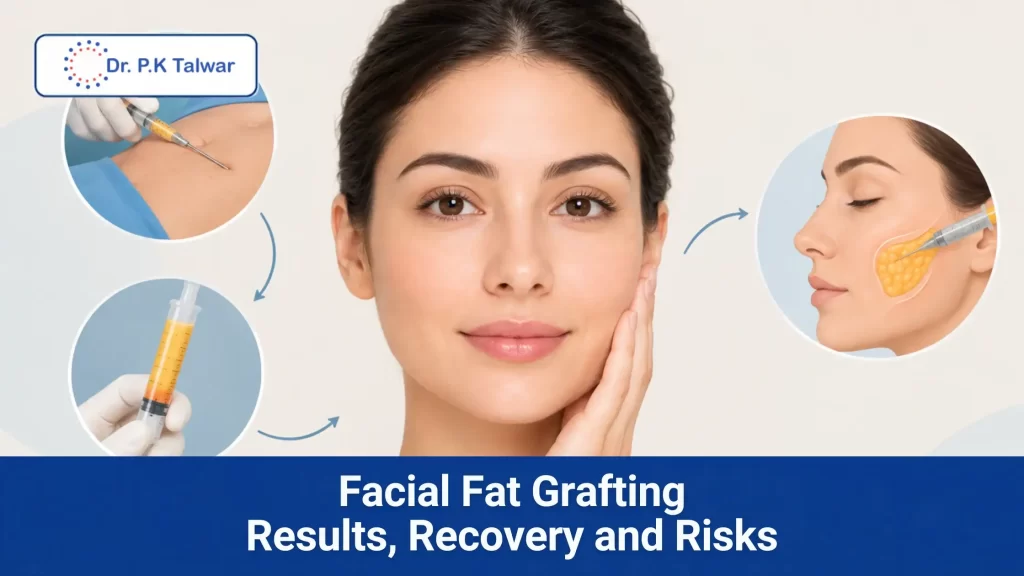
Facial fat grafting moves fat from one part of your body, like your belly or thighs, into your face to restore lost volume. The fat that survives can last for years but your body absorbs some of it. Swelling takes about two weeks to settle and the final look appears over several months.
Yes, you can lend your tummy’s extra fat to your cheeks. It’s the ultimate recycling program.
This article is for education and isn’t medical advice. A qualified plastic surgeon who examines your face can tell you what suits you.
What Is Facial Fat Grafting?
Think of your face as a pillow that loses stuffing over time. Fat sits under your skin and gives your cheeks, temples and under-eye area their soft, full shape. As people age, some of that fat shrinks.
Facial fat grafting puts volume back. A surgeon takes fat from your own body and injects it into the thin spots in your face. Doctors also call it fat transfer or autologous fat transfer. “Autologous” just means “from you”
Because the fat comes from you, there’s little risk of an allergic reaction, according to Cleveland Clinic.
How Does Facial Fat Grafting Work?
The whole job happens in one visit, in three steps.
- Harvest – The surgeon removes fat with gentle liposuction. A blunt tube called a cannula slides through a tiny cut, often in the belly, flanks or thighs.
- Process – The collected fat contains oil, blood and dead cells. These can hurt the graft, so the team cleans the fat first. Methods include spinning it gently, filtering it or letting it settle.
- Inject – The surgeon places the fat in the face in tiny amounts. StatPearls, a medical reference, describes passes of about 0.1 mL each. Tiny amounts let each bit of fat connect to a blood supply.
Surgeons often add a little extra on purpose. Cleveland Clinic says the body absorbs about half of the transferred fat in under-eye transfers, so providers inject more than they need.
Is Facial Fat Grafting Permanent?
Here’s the honest answer: partly.
Fat cells that survive the move become part of your face, and they can last for years, even a lifetime. Cleveland Clinic says an under-eye fat transfer may last for life. A separate guide says surviving fat becomes permanently integrated into the surrounding tissue.
The catch is the word “surviving.” Not all of the fat makes it.
Published survival numbers don’t agree. Two guides put typical survival at 40% to 70%. One surgeon’s site says 60% to 80% survives long-term. Cleveland Clinic’s under-eye page suggests about half gets absorbed. A research paper adds that unpredictable long-term volume loss is the technique’s main limitation.
So nobody can promise an exact number for your face. Results can even differ from one side of the face to the other.
Weight matters too. Fat you transfer acts like fat anywhere else on your body, so a big weight gain or loss can change the result. Staying at a steady weight helps.
And no, grafting won’t stop the clock. Your face keeps ageing after the procedure.
Which Parts of the Face Get Fat Grafting?
Surgeons use it where the face has lost fullness. Common spots include the cheeks, the temples (the flat areas beside your forehead) and the area under the eyes.
One surgeon says areas with good blood flow, like the cheeks, temples and midface, tend to hold onto fat more reliably. That’s because grafted fat needs a blood supply to survive.
Under-eye work needs extra care. Cleveland Clinic says the area can look overly full at first, and the puffiness fades over the next four to six months.
Facial Fat Grafting vs Fillers
Fillers are the quick option. Fat grafting is the longer one.
One guide compares them like this:
| Comparision |
Facial fat graftin |
Hyaluronic acid filler |
|
How long it lasts |
Surviving fat is permanent |
About 12–24 months |
|
Predictability |
Lower (survival varies) |
Higher |
|
Recovery |
About 2–3 weeks |
1–3 days |
|
Best for |
Larger-volume restoration |
Smaller, targeted fixes |
The guide also notes that fat grafting may become more economical for people who keep paying for repeat filler. Consider the trade: you get lasting results, but you also get more downtime.
Facial Fat Grafting Recovery: What to Expect
Recovery has two parts: your face and the donor area where the surgeon took the fat.
Week 1
- Expect swelling and bruising. The American Society of Plastic Surgeons says swelling can last about two weeks.
- The area where the surgeon took fat may feel sore.
- Sleep with your head raised on two or three pillows. One guide recommends this for the first week.
Weeks 1 to 3
- Bruising usually fades in a week or two, says Cleveland Clinic.
- Your face can look overcorrected at first. That’s normal, because swelling and extra fat add puffiness.
- Don’t touch, massage or press on the treated areas for at least two to three weeks. One clinic says to avoid tight masks and facial rollers for four weeks.
- Most people return to light daily activity within a few days, but should skip hard exercise for a few weeks.
Months 1 to 6
- Puffiness settles as your body absorbs some of the fat. Cleveland Clinic says this takes about four to six months for under-eye transfers.
- One guide says the true result shows up three to six months after surgery.
- Surgeons often schedule check-ups at one week, one month, three months and six months.
Two habits help healing. Don’t smoke, because Cleveland Clinic says smoking can affect how your body heals after liposuction and fat transfer. And follow your surgeon’s aftercare list exactly.
Risks of Facial Fat Grafting
Most side effects are minor. A few are serious, so ask about both.
Common:
- Swelling, bruising and unevenness
- Overcorrection or undercorrection
- Small scars where the surgeon removed or placed the fat
Less common:
- Lumps or oil cysts. Grafted fat that doesn’t survive can form firm spots. Doctors call this fat necrosis.
- Infection.
- Asymmetry. One side can look fuller than the other.
Rare but serious: If fat enters a blood vessel, it can block blood flow. StatPearls says this can lead to blindness, and other sources link it to skin loss or stroke. This is why surgeons use blunt cannulas, small amounts and low pressure, especially near the eyes.
The lesson: the surgeon matters more than anything else on this list.
Who Makes a Good Candidate?
Facial fat grafting suits people who:
- Have lost volume in the cheeks, temples or under the eyes
- Have enough fat to harvest (a face needs only a small amount, unlike larger body procedures)
- Are in good health and don’t smoke
- Understand that results vary and have realistic goals
Not sure whether fat grafting or a filler fits you better? A surgeon can examine your face and explain the options.
How to Choose a Surgeon?
You wouldn’t let a stranger cut your hair for a wedding. Pick even more carefully for your face.
Book a consultation with a qualified Plastic Surgeon in Delhi and ask these questions:
- How many facial fat grafting procedures do you do each year?
- Do you use blunt cannulas and low-pressure injection?
- Can I see before-and-after photos of patients like me?
- What happens if too much fat disappears?
- Which risks apply to my face specifically?
A good surgeon answers calmly and in plain words. If you feel rushed, leave.
Frequently Asked Questions
Does facial fat grafting hurt?
The harvest often happens under local numbing medicine, though other anaesthesia options exist. Afterward, expect soreness in the donor area, plus swelling in the face.
Will I have visible scars?
You’ll have tiny marks where the surgeon removed and placed the fat. They’re usually minor, but they exist.
Could I need a second session?
Possibly. Because survival can’t be predicted exactly, one guide says a second session may be needed.
Is fat grafting the same as fat transfer?
Yes. People use “fat grafting,” “fat transfer” and “autologous fat transfer” for the same procedure.
Your Next Step
Write down what bothers you about your face, and bring photos. Then book consultations with two surgeons, compare their advice, and ask each one what happens if the fat doesn’t survive. Pick the one who explains the risks best.